

Your competitor has links from 400 websites. Your business has links from 90. The difference looks dramatic, but it does not tell you which link to pursue next.
Some competitor links came from old partnerships. Others point to products you do not offer, research you have not produced or articles that no longer exist. A few may come from publications that would welcome a useful contribution from your business.
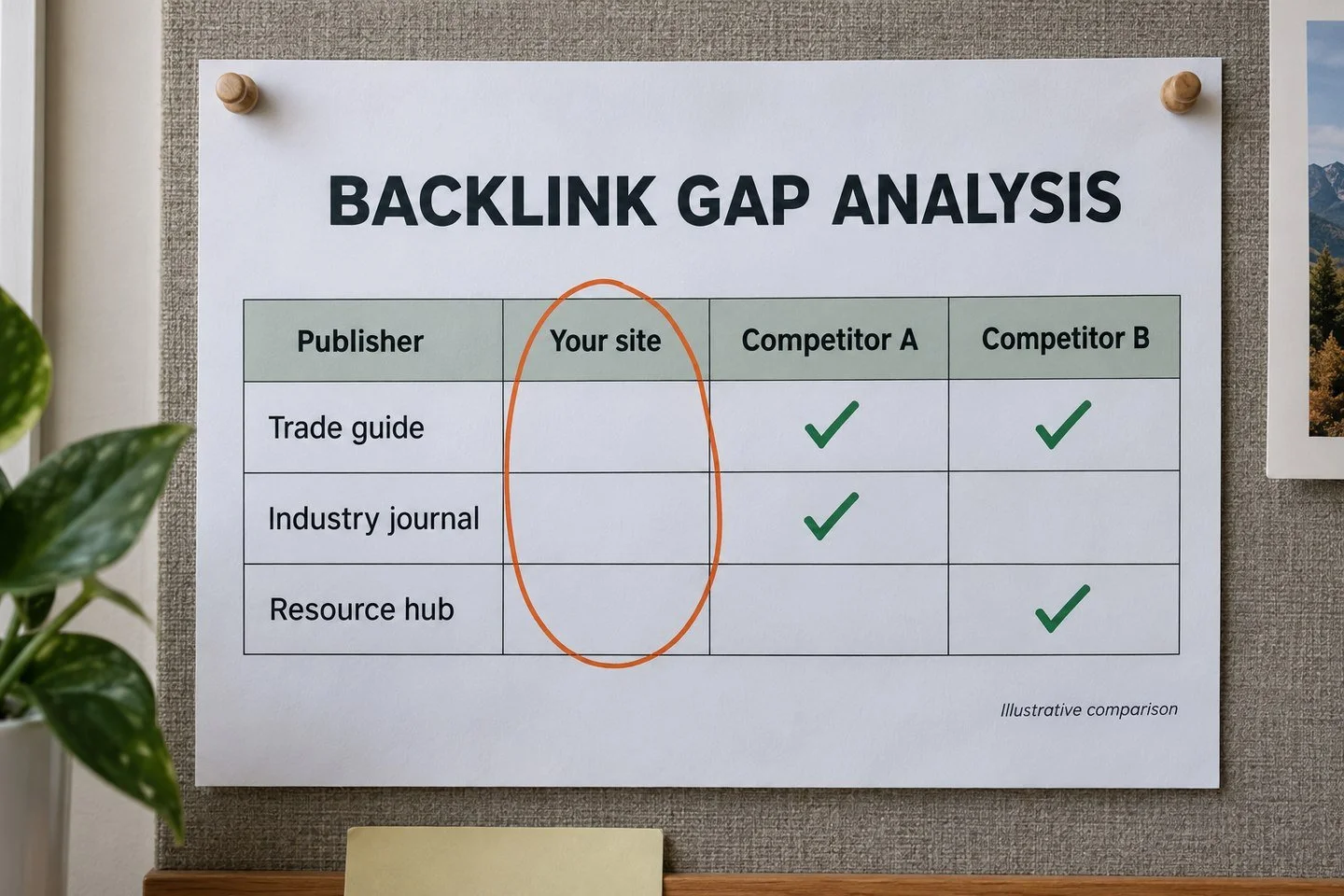
A backlink gap analysis identifies websites or pages linking to competitors but not to you. Its value comes from interpreting those differences. Exporting a list is the beginning of the work.
This guide shows how to choose useful comparison sites, inspect the reasons behind their backlinks and turn the findings into a realistic editorial outreach plan.
Choose a business question first
Decide what the analysis should help you do. A broad domain comparison can uncover publishers active in your industry. A page-level comparison can reveal why particular resources attract recommendations.
These are different questions. “Who covers scheduling software?” calls for a broader review. “Why do competing shift-planning templates earn links?” calls for a comparison of specific assets.
For a hypothetical scheduling software company, the second question might be more actionable. Its team already has a useful template, so the analysis can investigate publications recommending similar tools.
Write down the target page, audience, country and intended campaign type. If you serve US restaurant managers, international developer-documentation links may not belong in the initial shortlist.
Avoid beginning with a target number of links. The first goal is to understand where comparable resources receive relevant attention and why.
Select competitors that illuminate the question
Your sales competitors and search competitors may overlap, but they are not always identical. A software vendor, industry association and independent consultant could all publish shift-planning resources.
Search the topic your target page serves and note which pages satisfy the same reader task. Choose a small set with comparable content, then include a commercial competitor if it offers useful context.
An enormous publisher can reveal influential outlets but may be a poor model for immediate replication. Its links could depend on years of brand recognition and original reporting.
Likewise, comparing your single downloadable worksheet with a competitor's entire domain can produce an overwhelming list of unrelated links. Match the analysis level to the question.
Record why each comparator is included. “Ranks for the same template task” is more informative than “well-known company.” It also helps another reviewer challenge the selection before you invest time in data collection.
Gather comparable backlink data
Use one backlink provider for the main comparison and keep the scope consistent. Domain, subdomain, URL prefix and exact-page settings can return very different datasets.
Record the extraction date, target settings and filters. If you change the scope later, label the new dataset instead of mixing it silently with the first.
A referring domain is a website that links to a target. A backlink is an individual link. One publisher can create many backlinks, especially through navigation, duplicated pages or repeated syndicated material.
Start with referring domains to understand publisher coverage. Move to individual source pages when assessing editorial opportunities.
Ahrefs describes a tool-based workflow in its backlink gap analysis tutorial. Interface names can change; the essential comparison is which sources link to selected competitors and whether they also link to your chosen target.
No provider sees the complete web. Treat missing links as limitations of the dataset rather than proof that a relationship does not exist.
Clean the list before making judgments
Remove obvious duplicates and separate source types. A media article, business directory, partner page and scraper copy represent different opportunities.
Check whether apparently different publishers republish the same syndicated story. Ten copies of one release should not automatically become ten independent editorial targets.
Exclude clearly unrelated material from the active campaign, but retain an exclusion reason. It prevents another team member from rediscovering and reviewing the same unsuitable source.
Do not filter only by a high authority threshold. That can remove specialist publishers whose audiences are highly relevant. Use metrics to help organize the list, then inspect the actual source page.
If you want a consistent review standard, use Leo's existing explanation of website evaluation for backlink opportunities. This analysis should build on that quality review rather than replace it with competitor counts.
Ask why the competitor earned each link
Open the source page and the competitor destination together. Read the sentence around the link and identify the reason for inclusion.
Possible reasons include a cited study, a useful template, an integration partnership, a customer example, a paid promotion or membership in a relevant association.
Write the reason in plain language. For example: “The association recommends this worksheet because members need a printable shift schedule.”
Now compare your resource. Does it fulfill the same need? Does it add a different format, clearer instructions or a relevant example? Or does it merely cover the same broad topic?
A competitor's inclusion proves that a publisher linked to that competitor in that context. It does not prove the publisher will recommend you, that the arrangement was independent or that the link improved rankings.
If the source is sponsored, record that fact. Do not copy the placement into an earned-outreach list without examining its terms and editorial purpose.
Separate repeatable opportunities from historical advantages
Some links are useful clues but poor immediate targets. A founder's former university may profile an alumnus. A discontinued conference may list a sponsor. A company acquisition may generate coverage you cannot recreate.
Call these historical or relationship-dependent links. They may suggest a broader category of opportunity, but they do not justify sending the same request to the same publisher.
Other sources are more accessible: a maintained list of resources, an editor covering a recurring subject or an association with transparent membership criteria.
Classify each candidate as actionable now, dependent on a new asset, dependent on a legitimate relationship, or unsuitable for the campaign.
This step changes the meaning of the gap. You are no longer looking at “310 missing domains.” You are looking at a smaller set of editorial opportunities and the conditions required to pursue them.
Use a worked example to prioritize
Imagine the scheduling company compares three shift-planning resources and finds five candidate publishers. The following is an illustrative dataset, not a client result.
Hospitality association toolkit: Competitors linked: 2; Reason for the link: Printable scheduling resource; Next action: Check eligibility and pitch matching worksheet
Software integration directory: Competitors linked: 3; Reason for the link: Working product integrations; Next action: Refer to partnerships team; no integration, no pitch
Management newsletter: Competitors linked: 1; Reason for the link: Original staffing survey; Next action: Consider a future evidence project
Startup launch roundup: Competitors linked: 1; Reason for the link: News about a launch two years ago; Next action: Exclude from this resource campaign
Restaurant training guide: Competitors linked: 2; Reason for the link: Example weekly roster; Next action: Review whether your filled example adds value
The sources linking to multiple competitors are worth reviewing, but count alone does not determine priority. The integration directory links to all three competitors and still may be inaccessible to your current product.
The newsletter links to only one competitor yet could become valuable if your company has credible, original evidence to contribute.
Build a practical priority system
Score or label the factors your team can explain: audience fit, resource fit, editorial accessibility and effort needed to close the content gap.
Use a simple decision rule before numerical scoring. If the destination does not help the publisher's audience, do not pursue the opportunity merely because several competitors appear there.
For viable candidates, estimate the next step. One may need a small worksheet improvement; another may require a study involving several departments. The second could be valuable but belong in a later quarter.
Keep metric estimates separate from judgments. “Estimated page traffic: 80” and “strong fit for US restaurant managers” describe different things and should remain separate fields.
A useful shortlist tells the outreach writer what to propose. Include the source URL, intended destination, missing contribution, contact route and reason the request is reasonable now.
Do not turn the analysis into a copying exercise
The point is to learn how publishers recognize useful information. Reproducing a competitor's article or copying their outreach angle adds little value and can create avoidable problems.
If several publishers cite the same original dataset, inspect what information they needed. Your business might contribute a different, well-documented dataset serving a narrower audience.
If useful templates attract links, build a template that solves a real problem your team understands. Do not simply change colors and call the resource original.
Sometimes the best response is to improve your target page before contacting anybody. A gap analysis that identifies a weak destination has already produced a useful result.
Also respect commercial and technical boundaries. A listing requiring a genuine integration, accreditation or membership cannot be recreated with a persuasive email.
Check outcomes against the original question
After outreach, track what happened to the qualified opportunities. Did the publisher accept the suggestion, decline it, request a different resource or explain an eligibility restriction?
Compare results by source type and reason for inclusion. A small number of responses can reveal that your worksheet format is wrong or that the audience needs a different example.
Verify live links before reporting them. Record the destination, context, link qualification and first confirmed date. Keep newly discovered links distinct from links your team helped secure.
Revisit the analysis when the target resource or market changes. Repeating the same export every week without acting on it rarely improves the campaign.
A useful backlink gap analysis ends with decisions: which publishers to approach, which content to improve and which apparent gaps to ignore.
For help turning those decisions into outreach, review Leo Corado's link-building focus and service scope. Bring a target resource and competitor examples when you discuss a campaign, so the conversation starts with a clear business question.