

A client opens a monthly report and sees twelve URLs, twelve authority scores and a green arrow. They still do not know which links are live, which pages received them or what the campaign should do next.
A useful link building report connects three levels of information: the work completed, the recommendations verified and the business outcomes observed. Keep them distinct so one level does not imply proof of another.
This guide includes a copyable reporting structure, a placement register and worked calculations. Use it to explain a campaign clearly to an experienced SEO or a business owner reviewing outreach for the first time.
The worked examples use hypothetical campaign data to demonstrate the methods and calculations. They are not industry performance benchmarks.
Start with the reporting period and purpose
State the dates, campaign objective, target audience and pages being promoted. Explain any changes in scope during the period.
For example: “September campaign: promote the public inventory-count worksheet to US small-business and warehouse-management publications.”
That sentence gives the reader a standard for judging relevance. Without it, a list of unrelated placements can look productive simply because the total increased.
Identify the data sources and their dates. Your outreach log, manual link checks, analytics platform and backlink provider report different observations. They may not update at the same time.
Define what “verified” means for this report. A practical definition is that a reviewer opened the live source page, confirmed the hyperlink and checked the destination and context on the stated date.
Use a short executive summary
Lead with the decisions the reader needs to understand. Describe completed work, important limitations and the next action.
A hypothetical summary could read:
Four relevant placements were verified during September. Two pending articles remain with publishers and are excluded from the live total. One older recommendation was lost after an article update. Next month, the team will prioritize association resources because they produced the clearest audience fit in this test.
This summary separates verified output, pipeline and retention. It does not claim that four links caused a ranking change.
Keep the summary short enough to read before opening the detailed register. If a serious problem exists, such as a broken campaign destination, state it here rather than hiding it behind a chart.
Copy this monthly report structure
The following outline can be pasted into a reporting document. Replace the example prompts with the campaign's actual information.
Period and objective: Date range, audience, target resources and scope changes
Executive summary: Verified progress, important problems and next decision
Activity: Candidate review, qualified prospects, outreach and substantive replies
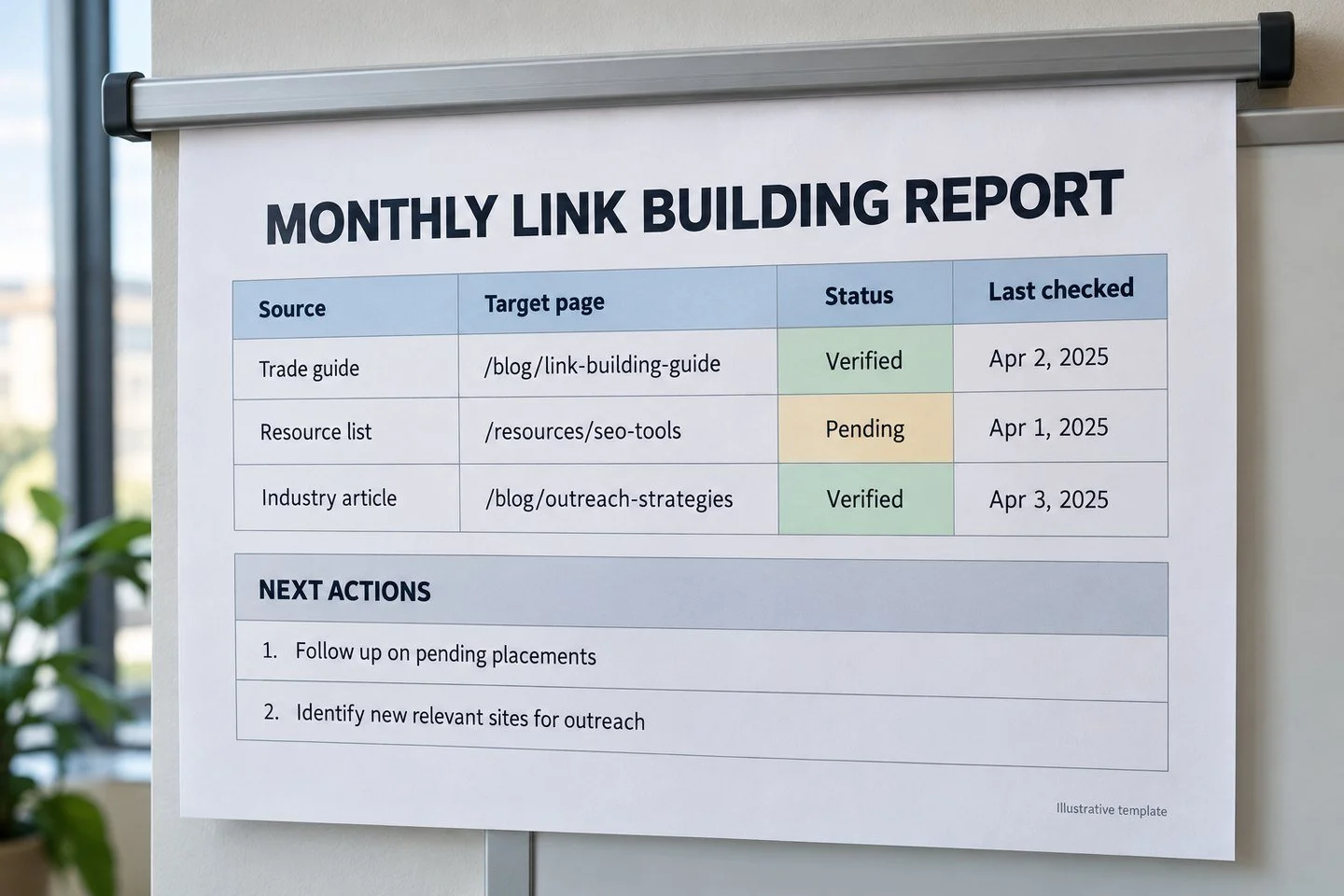
Placement register: Source, target, anchor, arrangement and verification evidence
Retention: Previously verified links retained, lost or unresolved
Audience outcomes: Observed referral activity and relevant inquiries, where measurable
Search context: Target-page impressions, clicks and other changes affecting interpretation
Next actions: Specific action, owner, due date and reason
Do not retain empty sections merely to make the report longer. If a data source is unavailable, say that clearly and explain what the report can establish without it.
Maintain a placement register with evidence
The register is the factual foundation of the report. Record each placement separately, using stable definitions throughout the campaign.
Source URL: Exact live page containing the recommendation
Referring domain: Publisher domain for deduplication
Target URL: Final destination on the client's site
Anchor: Clickable wording actually present
Context: Short explanation of why the destination fits
Arrangement: Earned recommendation, sponsored placement, recovery or other accurate category
Link qualification: Attributes observed during verification
First verified: Date the team first confirmed the live placement
Last checked: Most recent review date
Current status: Live, changed, lost or unresolved
Owner and action: Person responsible for any follow-up
If publication date is known, record it separately from verification date. A newly discovered article may be older than the reporting period.
Avoid counting every repeated link from one publisher as a new referring domain. The link count and unique domain count answer different questions.
Report activity without confusing it with success
Activity explains the work behind placements. Useful counts include candidates reviewed, qualified prospects, valid contact routes, requests sent and substantive responses.
Define the denominators. A reply rate based on messages sent differs from one based on valid contacted publishers. Neither should be presented without explaining the calculation.
Suppose a fictional campaign reviews sixty candidates, qualifies twenty-four, contacts twenty publishers and receives five substantive replies. The response rate among contacted publishers is five divided by twenty, or 25%.
That figure is an illustration, not a benchmark. It excludes delivery failures only if the stated definition says so; do not silently change the denominator to make performance look stronger.
If four placements follow, report them as four verified placements. Do not relabel all five replies as successful links or treat the remaining conversation as a failure before its outcome is known.
Keep pipeline separate from live output
Use statuses that reflect actual progress. “Interested” means the publisher expressed interest. “In review” means the contribution is being assessed. “Scheduled” means a publication date has been provided. “Verified live” means you checked the page.
Assign an owner and next action to pending records. A pipeline with no follow-up responsibility is a list of hopes.
Report delays in context. A publisher's editorial calendar may explain a long wait, while missing client approval may be an internal bottleneck.
Do not imply control over a publisher's schedule. A positive reply should remain pending until the actual placement exists.
This separation also makes forecasting more cautious. Pipeline can indicate possible future output, but it should not be added to completed results in the headline total.
Track retention as its own measure
New links are only part of the picture. Review important previously verified placements and record what remains live.
For a simple cohort measure, take the set of links verified at the start of the review window. If eighteen of twenty remain confirmed live, the observed retention rate is eighteen divided by twenty, or 90%.
Keep unresolved cases separate. A temporarily inaccessible source should not automatically be labeled permanently lost.
Also distinguish restored links from new acquisitions. Recovering a previous recommendation is useful work, but it does not necessarily add a new publisher relationship.
Explain material changes: a removed article, a changed destination, new qualification or a technical problem on the client's site. The report should make the appropriate next action clear without assuming every loss requires an editor email.
Add referral and business outcomes where available
Use analytics to review visits attributed to referring publishers, then examine the actions relevant to the business. These might include resource use, inquiries or product signups.
State the measurement limitations. Referrer information can be missing, blocked or affected by how a visitor returns later. A low reported referral count does not establish that nobody saw the article.
Avoid appending tracking parameters to every editorial destination without considering the publisher's policy and the site's measurement setup. A stable destination and clear reporting definitions are more valuable than improvised attribution.
If an inquiry can be connected to a source, explain the evidence. If it cannot, report it as an observed business outcome without assigning it to link building.
The report should make uncertainty understandable rather than hide it behind an overly precise revenue figure.
Present search performance as context
Review target-page impressions and clicks when Search Console data is available. Note the country, period and page filters used so comparisons are meaningful.
If you include rankings, explain the keyword set and tracking location. One keyword's movement is not the same as the performance of the whole page.
Record other changes during the period: content updates, technical fixes, seasonality, product launches and major site changes. These can affect interpretation.
Do not claim that links caused a traffic increase merely because both occurred in the same month. A sound report can show an encouraging association while explaining that causation has not been established.
When search data is unavailable, leave it unavailable. Do not substitute a vendor estimate and label it as the client's measured traffic.
Explain costs only within a defined scope
If the report includes acquisition costs, state what is included: research, outreach, content, coordination, promotion or other agreed work.
Dividing total campaign cost by verified placements can be a useful operational measure, provided the denominator and scope are clear. It is not a direct measure of each link's business value.
Do not compare an all-inclusive specialist engagement with a publisher-only fee as though they were identical services. The existing SaaS link-building cost article discusses that distinction in more detail.
Retain earned and sponsored categories in the register even if costs are summarized elsewhere. The arrangement behind a placement matters to how the client interprets the result.
Finish with actions that change the next month
Choose actions supported by the evidence. If association pages produced useful conversations, expand that source type. If several destinations broke, repair and verify them before more promotion.
Give each action an owner and a date. “Improve outreach” is too vague; “review the twenty declined prospects for eligibility errors before the next batch” is observable.
Keep source-quality decisions linked to a consistent standard. Leo's website evaluation guide can help explain what the campaign considers a suitable recommendation.
For reporting and outreach support, visit Leo Corado and review the link-building service scope. When you discuss a campaign report, bring a few placement records and the business questions the report needs to answer.
A good monthly report leaves the reader able to verify the work, understand its limits and approve a sensible next step.