

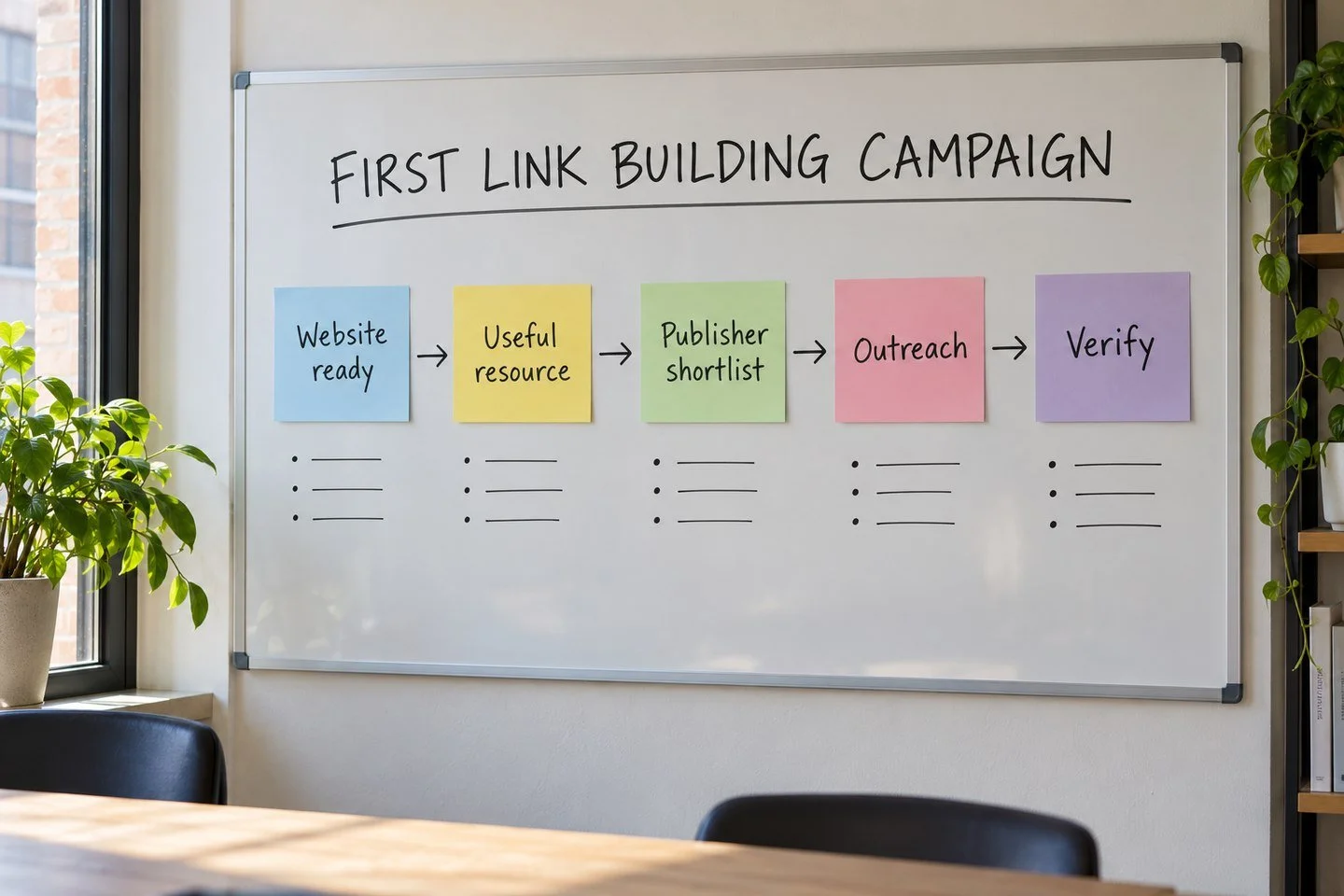
A startup launches its website, publishes a few articles and receives a proposal for fifty backlinks. It feels like a shortcut to visibility. Yet nobody has checked whether the site explains the product clearly or whether those links would reach the right audience.
Early link building works better when it follows the startup's stage of development. A team still clarifying its positioning needs a different campaign from a company with customer evidence, useful resources and a defined search strategy.
The first objective is to earn relevant attention for something worth recommending. That requires a suitable destination, a credible contribution and enough operational focus to learn from a small campaign.
This guide explains how to sequence that work without turning a new business into a full-time outreach operation.
Decide whether you are ready to promote the site
Open the page you want publishers to recommend. Can a new visitor understand what the business does, who it serves and what to do next?
A confusing homepage, broken signup flow or unfinished About page creates friction for both readers and editors. Fix those issues before increasing attention.
Check the basic search setup as well. Important public pages should be accessible and intended for indexing. Confirm that mobile visitors can use the resource and that major redirects work as expected.
These checks do not require a perfect website. They establish a minimum standard: the destination should fulfill the promise of a recommendation.
For a hypothetical appointment-scheduling startup, a practical guide for independent tutors may be ready to promote even while the wider content library is small. An empty “coming soon” blog is not an equivalent asset.
Choose a first outcome your team can influence
“Rank for our main keyword” is a business aspiration, but it is too distant to guide every action in an initial outreach test.
Choose an operational outcome, such as identifying suitable publications, learning which resource editors find useful or securing verified recommendations from relevant sources.
Connect that outcome to a business purpose. The tutoring startup might want more independent educators to discover its availability-planning worksheet. That purpose narrows the audience and suggests where to look.
Avoid promising a certain ranking increase from a fixed number of links. Search results depend on the destination, competition, technical condition and other factors beyond the outreach campaign.
Write a one-paragraph brief covering the audience, target page, contribution, exclusions and person responsible for approvals. A small team benefits from clarity because it cannot afford repeated rework.
Select one destination with a clear job
A first campaign often becomes scattered when every department wants links to a different page. Start with a destination that supports one useful task.
For the tutoring business, the options might include the homepage, a product feature page or a free availability worksheet. The best choice depends on the publisher and context.
A startup directory may reasonably link to the homepage. An educator's planning guide may prefer the worksheet. A review of booking tools may need the feature page.
Do not insist that every link point to the most commercial destination. The page should match what the source is recommending.
Keep the resource usable without a sales call. Include instructions, a realistic example and clear ownership. A focused, dependable tool can give an editor a better reason to link than a long introductory article repeating familiar advice.
Inventory the evidence you already have
New businesses sometimes assume they have nothing worth sharing because they lack a large research budget. Look more closely at the expertise and material already available.
You may have a founder with relevant professional experience, a clearly documented implementation process, an original tool or an explanation of a recurring customer problem.
Separate evidence from opinion. A founder can describe a practical tradeoff they understand, but should not claim industry-wide results from a handful of conversations.
For the tutoring example, the team might explain how to handle recurring versus irregular availability, using a fictional timetable. It should label that timetable as an illustration rather than present it as customer research.
Also identify what you cannot substantiate. Unsupported claims about adoption, revenue, security or effectiveness should not become the foundation of an outreach pitch.
Start with legitimate existing connections
Review relationships that already have a clear reason to mention the business: an accelerator, a relevant association, a genuine integration partner or an event where a founder contributed.
Check whether an accurate business profile or resource listing is available under the organization's normal rules. Do not manufacture partnerships or claim eligibility you do not have.
A listing should help people understand the business, rather than exist solely to create another backlink. Follow the organization's editorial requirements and represent commercial arrangements accurately.
Avoid turning relationship review into a request for reciprocal links across every contact. An authentic connection does not obligate anyone to recommend your website.
For startups with little existing visibility, this stage may produce only a few opportunities. That is useful information. It indicates that the next campaign needs a stronger public contribution instead of a larger contact list.
Run a narrow editorial outreach test
Choose one audience and one contribution. Build a small list you can review personally, with a clear reason for every candidate.
The tutoring startup could focus on publications helping independent educators manage their work. Its contribution is a free worksheet with examples of weekly availability patterns.
For each prospect, identify the relevant page or editorial subject, the fit of the worksheet and the appropriate contact route. Exclude lists that accept only accredited training providers if the startup does not qualify.
Review publisher quality before sending. Leo's guide to evaluating websites for backlinks explains why the exact context matters alongside domain metrics.
The campaign should produce learning even when a publisher declines. A response explaining that tutors need a printable format can guide a useful improvement to the resource.
Assign ownership so outreach does not stall
A small campaign still needs decisions about messaging, product accuracy and publication terms. Name one person who can approve routine requests.
Define what needs specialist review. A technical claim may require the product lead; a new case study may require customer permission; a sponsorship offer may need a separate commercial decision.
Keep the outreach writer supplied with current facts. If the free plan changes or the worksheet moves, update the brief immediately.
Use a shared log containing the source page, contact route, destination, fit note, status and next action. This can be a simple document or spreadsheet. The essential feature is that everyone sees the same state.
Avoid measuring productivity solely by messages sent. A carefully excluded prospect can save more time than another email creates value.
Keep paid promotion distinct from earned outreach
Startups encounter many offers promising fast authority. Examine what is actually being sold and what editorial control the publisher retains.
If payment or another benefit is required for inclusion, describe it accurately. Evaluate the opportunity as promotion and use appropriate disclosure and link qualification.
Google's link spam policies are relevant to arrangements designed to manipulate rankings. A placement package does not become an independent endorsement because the article looks professional.
You can compare service scopes without assuming every quote covers the same work. Leo's existing SaaS link-building cost discussion explains why research, coordination and reporting belong in that comparison.
This first campaign guide concerns sequencing and readiness. Keep detailed pricing decisions tied to your actual scope and current quotes.
Use a first-month plan as a working structure
The following schedule is an illustrative operating plan, not a promise that links will appear within thirty days.
Week one: Confirm the target audience, destination and basic website readiness. Gather the facts and examples that support the contribution.
Week two: Review a small prospect set and improve the resource where necessary. Establish a contact log and approval owner.
Week three: Send a limited set of relevant suggestions. Track delivery issues, editorial questions and responses. Avoid changing every part of the campaign after one rejection.
Week four: Verify any published recommendations, review feedback and decide whether to continue, revise or stop the test.
Publication timing belongs to the publisher. A well-run first month may end with useful conversations rather than live links. Report that state honestly instead of treating a positive reply as a placement.
Evaluate what the test actually taught you
Compare the campaign with its original purpose. Did the intended audience and resource fit produce plausible editorial interest?
If most pages were ineligible, improve discovery. If editors misunderstood the asset, improve the page or pitch. If they liked the resource but requested a different format, assess whether the change would help users beyond this campaign.
If a few links appear, verify the destinations and record their context. Monitor referral visits and relevant inquiries where your measurement setup supports it.
Search impressions and clicks can provide additional context after indexing, but do not attribute every movement to the new links. A startup often changes its website, product and content rapidly, making simple before-and-after claims unreliable.
Use the evidence to decide the next investment, rather than scaling because the first sequence has ended.
Know when external help makes sense
A specialist can help when the team has a clear strategy and useful destination but lacks time for publisher research, outreach and placement verification.
A specialist cannot compensate for a product page that does not explain the offer or a resource that adds nothing to the audience. Establish who owns those improvements before agreeing on delivery targets.
Ask a provider how prospects are selected, what the reported outcomes mean and how paid placements are distinguished from earned recommendations. Review scope, communication and approval responsibilities as carefully as link counts.
Leo Corado supports link building and publisher outreach. You can review the service scope for agencies and businesses or discuss your startup's first campaign with a defined audience and target resource.
The most useful first campaign gives you a repeatable way to make sound decisions. Once the destination, contribution and editorial fit are working together, you have a stronger basis for expanding the effort.