

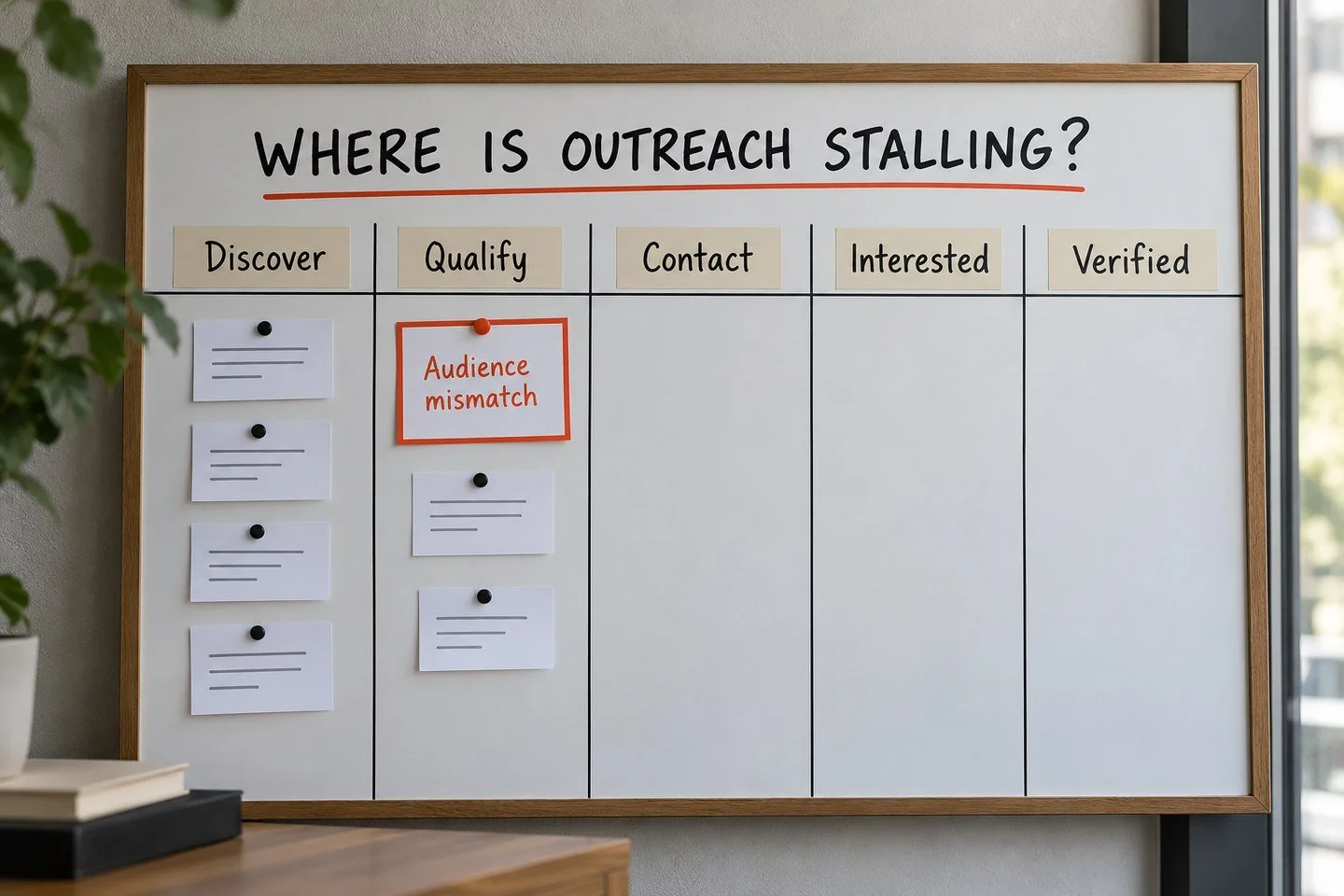
Your team has sent a hundred outreach emails and earned no verified links. The instinct is to rewrite the subject line or double the next batch. Neither change helps if the underlying problem is an unsuitable resource or an ineligible prospect list.
Common link building mistakes become easier to fix when you locate where the campaign stops progressing. Discovery, qualification, contact, editorial interest and publication are different stages. Each can fail for a different reason.
This article is a troubleshooting guide for an active campaign. It explains how to diagnose the problem, test a sensible correction and avoid turning a small setback into a larger version of the same mistake.
Mistake 1: Treating every discovered website as a prospect
A search result or competitor backlink is a candidate for review. It becomes a prospect when you can explain why a particular page or publication could use your contribution.
Suppose a fictional inventory software company collects business websites mentioning stock management. Many results concern investing in stocks rather than managing warehouse inventory. Sending a polished email to those publishers will not fix the discovery error.
Review a sample before launching outreach. Ask whether each page serves the intended audience, accepts the relevant type of contribution and has a reasonable place for the destination.
Record exclusion reasons. If most candidates fail because of language, geography or eligibility, change the discovery method. If they fail because the resource adds little, improve the contribution.
Do not use the number of collected domains as evidence that a campaign has a large addressable opportunity.
Mistake 2: Sending readers to the wrong destination
A relevant publisher can still receive an unsuitable pitch. The article may discuss a practical problem while your suggested link leads to a general sales page.
For the inventory company, a publication explaining cycle counting may need a clear worksheet or worked example. A homepage describing all the software's features does not necessarily fulfill that need.
Read the source context and destination together. Write the expected reader action: download a worksheet, verify a statement, compare a feature or understand the business.
If the destination cannot support that action, choose a better page or pause the pitch. Changing the anchor text does not repair a mismatch in the underlying resource.
Keep this review specific. You are diagnosing the campaign's contribution, not repeating a general audit of every page on the site.
Mistake 3: Confusing a delivery problem with an editorial rejection
No response can mean many things. The address may be wrong, the message may not have arrived, the person may be away or the suggestion may not interest them.
Separate clear delivery failures from silence. Review bounced addresses, published contact instructions and obvious routing errors before changing the content strategy.
Use a legitimate sender identity and an address connected to the business or authorized outreach team. Do not impersonate an employee or invent a previous conversation to improve the apparent response rate.
Treat open tracking cautiously. An image load or privacy feature does not prove a person read the message, and a missing open does not prove they did not.
For persistent technical delivery issues, involve the person responsible for the email system. Randomly changing subjects and sending more messages can obscure the original problem.
Mistake 4: Personalizing the greeting while ignoring the page
Adding a first name is not enough to make a pitch relevant. The useful personalization explains why the contribution belongs in this editorial context.
“I enjoyed your excellent blog” tells the recipient little. “Your cycle-counting guide explains the counting schedule but does not include a sample variance log” identifies a concrete point they can evaluate.
Make sure the observation is accurate. Do not claim to have used a tool or read a study if you have not. False familiarity can make a small suggestion feel manipulative.
A good message names the relevant subject, describes the contribution and asks one reasonable question. Remove background details that the editor does not need to decide.
Test relevance before testing clever phrasing. If a reviewer cannot explain why the target page deserves attention, the campaign is not ready for subject-line experiments.
Mistake 5: Asking for several favors at once
Some emails request a backlink, a guest post, a partnership call and a product trial in the same message. The recipient cannot tell which action matters.
Choose the smallest decision that moves the conversation forward. For a resource suggestion, ask whether the asset suits the relevant section. For an expert contribution, offer a specific qualified answer.
Do not attach a full media kit when a short explanation and one working URL will do. Additional material can follow if the editor asks for it.
Avoid making the publisher approve exact anchor wording, placement location and promotional claims before it has decided whether the contribution is useful.
A focused request is easier to route internally. It also makes replies interpretable: the editor is responding to one proposal rather than choosing among several unrelated offers.
Mistake 6: Following up without a reason or a stop rule
Repeated reminders can become the most visible part of an otherwise thoughtful campaign. Decide in advance when a follow-up is reasonable and when the conversation ends.
For a small manual test, one reminder after a suitable working interval can be a conservative starting policy. Adjust it for the publisher's stated process and any deadline. It is a team rule, not a proven universal conversion formula.
Check the live page and previous replies first. A link may already have appeared, another colleague may have received a response, or the editor may have declined.
An illustrative follow-up for the fictional inventory worksheet could read:
Hi Taylor,
Following up on the cycle-count variance log I sent for your warehouse guide. The worksheet includes a filled example as well as the blank version, which may make it easier to assess.
If it does not fit your resource criteria, no further reply is needed. Thanks for considering it.
Stop after a refusal or a request not to contact. Do not switch channels to continue the same unwanted request.
Mistake 7: Counting replies as placements
A positive response is progress, but the link may still require content review, scheduling or approval. Reporting it as live creates a misleading picture.
Use distinct statuses: interested, reviewing, accepted in principle, published and verified. Name an owner and next action for each pending item.
After publication, open the actual page. Confirm the destination, context and link qualification. A publisher's confirmation does not replace this check.
Similarly, a newly discovered backlink may have existed before your campaign. Keep discovery date and first verified date separate from any known publication date.
Clear status definitions help clients understand delays without inflating results. They also reveal whether the real bottleneck is outreach interest or publication coordination.
Mistake 8: Mixing commercial arrangements into earned results
If an editor responds with a sponsorship offer, evaluate that as a new arrangement. Do not continue describing the outcome as an independent recommendation.
Record the terms, disclosure and qualification expected for paid promotion. Explain the audience or advertising purpose rather than presenting a fee as proof of SEO value.
For background on link attributes, consult Google's outbound link documentation. Keep the commercial facts visible in the report regardless of the terminology a vendor uses.
Do not accept a placement solely because its cost is lower than another offer. Leo's existing SaaS acquisition-cost discussion shows why scope and delivery work belong in the comparison.
This diagnostic is about knowing what happened at each campaign stage. Accurate labels are part of that diagnosis.
Mistake 9: Changing everything after a small sample
One rejection does not prove the asset is weak. One positive reply does not prove the subject line is excellent. Small campaigns provide limited evidence.
Group feedback by reason before making changes. Several comments about an inaccessible download suggest a concrete fix. A few unrelated refusals may simply reflect normal editorial discretion.
Change one meaningful variable at a time when practical. If you change the audience, asset, sender and message together, you will struggle to understand which change mattered.
Record the test conditions and dates. Compare similar prospect groups rather than treating all outreach as one undifferentiated total.
Use qualitative feedback alongside counts. A clear explanation from a relevant editor can teach you more than a small difference in response percentages.
Use the campaign stages to locate the problem
The following fictional example shows why total email volume is a poor diagnosis.
| Stage | Observed result | Useful question |
|---|---|---|
| Discovery | 80 candidate pages collected | Are the queries finding the right subject? |
| Qualification | 22 pages meet the brief | Why were 58 excluded? |
| Contact | 18 valid routes identified | Is contact research slowing the campaign? |
| Response | 5 substantive replies | What reasons do editors give? |
| Publication | 2 links verified | What is pending versus declined? |
These are invented figures for illustration, not performance benchmarks. The review might show that discovery produces too much irrelevant material while the qualified outreach is reasonably productive.
Sending another eighty unreviewed emails would expand the least effective stage. Improving the query set would address the actual problem.
End the review with one concrete correction
Choose the most important bottleneck, identify its owner and define the next check. Examples include fixing the download before further pitches, narrowing the audience or verifying pending publications.
Do not turn every review into a long list of vague improvements. A campaign becomes easier to manage when the next action is observable and limited.
For publisher suitability, use the existing website-quality evaluation guide. For help managing the wider workflow, explore Leo Corado and the link-building service scope.
When you discuss a stalled campaign, bring examples from each stage. A handful of real records usually provides a better starting point than a single claim that outreach is not working.