

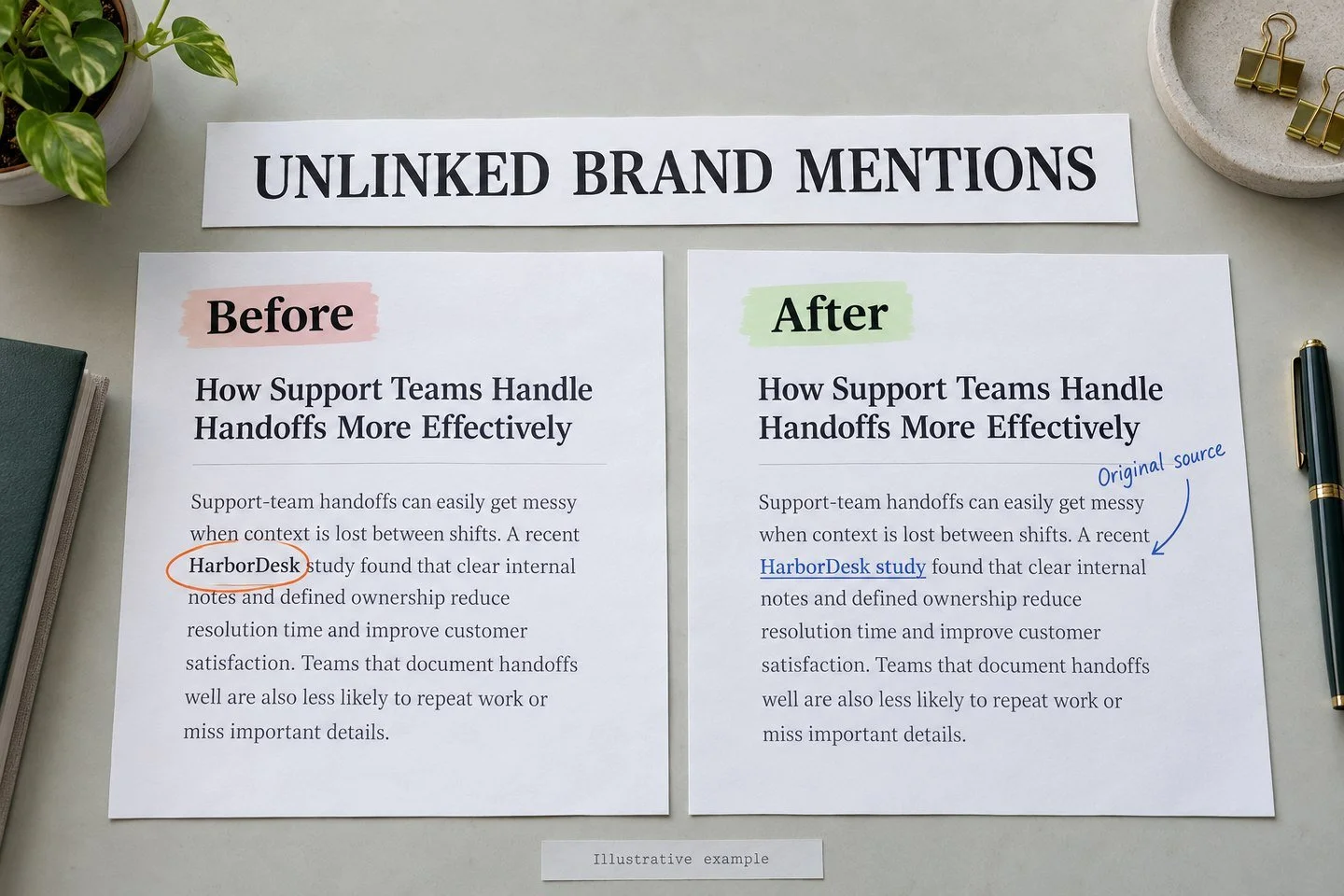
A publication names your business in a useful article but gives readers no way to reach it. You already have the mention. The next decision is whether a hyperlink would improve the article and where it should point.
An unlinked brand mention is a reference to a brand, product or identifiable business entity without a hyperlink to a relevant destination. Finding these mentions can reveal opportunities for small editorial updates.
The process is different from recovering a lost backlink. In a mention campaign, the name may never have been linked. In reclamation, a link or its useful destination previously existed and needs repair.
This guide explains how to find mentions, verify that they refer to your business, prioritize suitable pages and make a request the publisher can evaluate quickly.
Decide which names belong in the search
Begin with a short inventory of names people use for your business. Include the official brand, common spelling variants, distinctive product names and previous names that remain relevant.
Add a founder or expert only when their mention has a genuine connection to the business and a suitable attribution destination. A personal reference is not automatically a company link opportunity.
Ambiguous names need additional context. A fictional software brand called HarborDesk may be relatively distinctive. A business called Summit needs product, location or industry terms to separate it from unrelated references.
Record the purpose of each name. That helps reviewers avoid approaching a publisher about the wrong company or asking for a business link in an unrelated personal story.
Do not broaden the list indefinitely. A focused set of genuine identities is more manageable than every phrase loosely connected to your industry.
Find mentions through search and monitoring
Start with quoted brand searches and exclude your own website. For the fictional example, a query such as "HarborDesk" -site:yourdomain.com can reveal outside references. Replace the example domain with your actual domain.
Try relevant variants separately, then inspect the pages. Search results may show old snippets, duplicates or references that are no longer present.
Monitoring services and content databases can help identify mentions over time. Their coverage differs, so do not interpret the absence of a result as proof that no mention exists.
Check recent coverage from launches, expert contributions and research projects. The team responsible for those activities may already know where the brand appeared.
Ahrefs provides a guide to finding unlinked mentions with tool-based approaches. Whatever method you use, manual verification remains necessary before contacting a publisher.
Verify the mention on the live page
Open the article and find the reference. Confirm that the name identifies your business and that the context is accurate.
Then inspect whether a link already exists. A brand name may be plain text while a nearby product name or image links to the site. A browser extension or content tool can help, but the visible article and actual destination are the relevant evidence.
Check the whole context before deciding that the mention is unlinked. If the publication already provides a useful route to your resource, another hyperlink may add little.
Also note whether the article is original or syndicated. Multiple copies of one story can require a different approach from independent coverage. The republisher may have limited authority to change the original text.
Record the source URL, exact reference, date checked and any existing link. This prevents a discovery tool's label from becoming an unverified outreach claim.
Choose the destination the reference deserves
The homepage is appropriate when the article identifies the business generally. A product reference may deserve a product page, while a statistic should normally point to the underlying evidence.
Imagine HarborDesk published a study about how customer support teams organize handoffs. A writer cites a finding but leaves the study name unlinked. The study page is more useful than a generic homepage because readers can inspect the methodology.
If the article quotes the founder's expertise, a factual author profile may be the clearest destination. Avoid directing readers to an aggressive sales page that does not substantiate the reference.
Check the target before suggesting it. It should load, match the article's description and remain accessible without an unnecessary barrier.
If the original resource has moved, provide the best current equivalent and explain the change accurately. Do not disguise a different offer as the cited source.
Prioritize by context and likely reader benefit
Not every mention deserves a request. Start with pages that name your business positively or neutrally in a relevant, substantive context.
Consider the reader's reason to click. Are they likely to verify a source, inspect a tool or learn about the company described? A clear answer strengthens the editorial case.
Assess whether the publication appears active and whether you can identify an appropriate contact route. A recently updated specialist guide can be more actionable than an old archive with no responsible editor.
Use authority and traffic estimates as supporting context. They cannot establish whether an editor will add a link, and a small professional publication may serve an excellent audience.
Leo's existing explanation of website quality checks for backlinks can support that broader publisher assessment. Here, the additional question is whether linking the existing mention improves this article.
Leave some mentions alone
A negative review, sensitive personal story or legal dispute is usually a poor setting for a routine SEO link request. Address factual or customer-service concerns through the appropriate process instead of treating the article as an acquisition opportunity.
A publisher may have a clear policy against commercial links. Respect it. Another publication may already link to an appropriate source elsewhere in the story.
Do not request links from scraped copies, irrelevant spam pages or references to a different company with the same name. Those are exclusions, not missed opportunities.
An unlinked mention can still help people recognize a business. Its value does not disappear because the editor declines a hyperlink. Avoid promising a specific ranking effect from the name alone or from converting it into a link.
Keep the campaign focused on reader utility rather than a belief that every mention must be claimed.
Write a request around the exact reference
The publisher should not have to search the site to understand your message. Name the article, identify the reference and provide one suitable destination.
Here is an illustrative email for the fictional research example:
Subject: Source link for the HarborDesk handoff study
Hi Priya,
Your article on support handoffs cites HarborDesk's study in the section about ownership changes. Thanks for including the research.
The original report, including the sample and method, is available at [study URL]. Would you consider linking the study name so readers can inspect the source?
I work with HarborDesk and can help if you need clarification about the report.
Morgan
Replace the placeholder before use. The request explains a practical benefit and makes the relationship clear. It does not imply that the publisher owes a link or that a source citation requires a particular anchor.
Separate attribution from factual corrections
If the article gets a fact wrong, identify the issue and provide evidence. Do not make correction conditional on adding your preferred hyperlink.
For example, a product may be described as free when only a trial is free. Explain the actual terms and point to a reliable public source. The editor can correct the statement according to its standards.
Similarly, do not ask the publisher to remove a legitimate qualification or criticism in return for access to information. A link-building campaign should not interfere with editorial independence.
When several issues exist, make the priorities clear. Accuracy comes first. A separate, optional suggestion about linking the source can follow without turning the whole exchange into a promotional negotiation.
This distinction also helps internal teams route requests correctly. An SEO specialist may identify the page, while a product or communications owner supplies the factual answer.
Follow up with restraint
Choose a modest follow-up rule for the campaign. One concise reminder after a reasonable working interval can be enough for a small manual test; there is no universal schedule that makes every request appropriate.
Check that the article and contact remain current before following up. If the source link has already been added, close the record rather than sending a reminder automatically.
Stop when the editor declines or asks not to be contacted. If the publication offers a paid placement instead, review it as a separate commercial arrangement and describe it accurately.
Do not request an ordinary followed link as compensation for being mentioned. Publishers control link wording and qualification. A useful attribution can still serve readers when it follows the publication's linking policy.
The quality of the request matters more than how many reminders the software can send.
Verify and report the actual result
After an editor confirms an update, open the page. Verify that the link is live, points to the intended destination and sits in the expected context.
Record whether it is newly added, changed from another destination or already present when checked. These outcomes should not be counted identically.
Track qualified mentions reviewed, requests sent, responses and verified additions. Keep duplicates and exclusions outside the opportunity denominator so the report remains interpretable.
If a publication declines but corrects an inaccurate statement, record that as a useful communications outcome rather than pretending a backlink was secured.
Review important destinations over time. If the study or product page changes, maintain a relevant route for readers arriving through the article.
For a campaign built around relevant publisher conversations, visit Leo Corado and review the outreach service scope. When you share a mention for review, include the source article and the destination that best supports its reference.